Want to know more about our services? Call, mail, or send us a message.
Regulatory toxicology consulting provides independent scientific expertise for companies facing complex safety evaluations, regulatory submissions, and human health risk assessments. Whether you are preparing a regulatory submission, assessing product safety, responding to questions from regulatory authorities, or addressing a complex toxicological issue, the right expertise can make the difference between uncertainty and a well-supported decision.
Agirad provides independent regulatory and scientific support for pharmaceutical, veterinary pharmaceutical, medical device, chemical, food, feed, and cosmetic companies. Support includes toxicological risk assessments, health-based exposure limit derivation, regulatory documentation, and scientifically justified regulatory strategies that facilitate product development, regulatory compliance, and informed decision-making.
By combining regulatory expertise with practical toxicology, Agirad delivers clear, evidence-based recommendations that help organisations navigate complex regulatory requirements and make confident safety decisions throughout the product lifecycle.
Organisations typically seek regulatory toxicology expertise when they need to:
Why Agirad

Agirad provides independent regulatory toxicology expertise tailored to the scientific and regulatory challenges of each project.
A toxicological risk assessment provides the scientific basis for demonstrating product safety, supporting regulatory submissions, establishing health-based exposure limits, and protecting patients, consumers and workers.
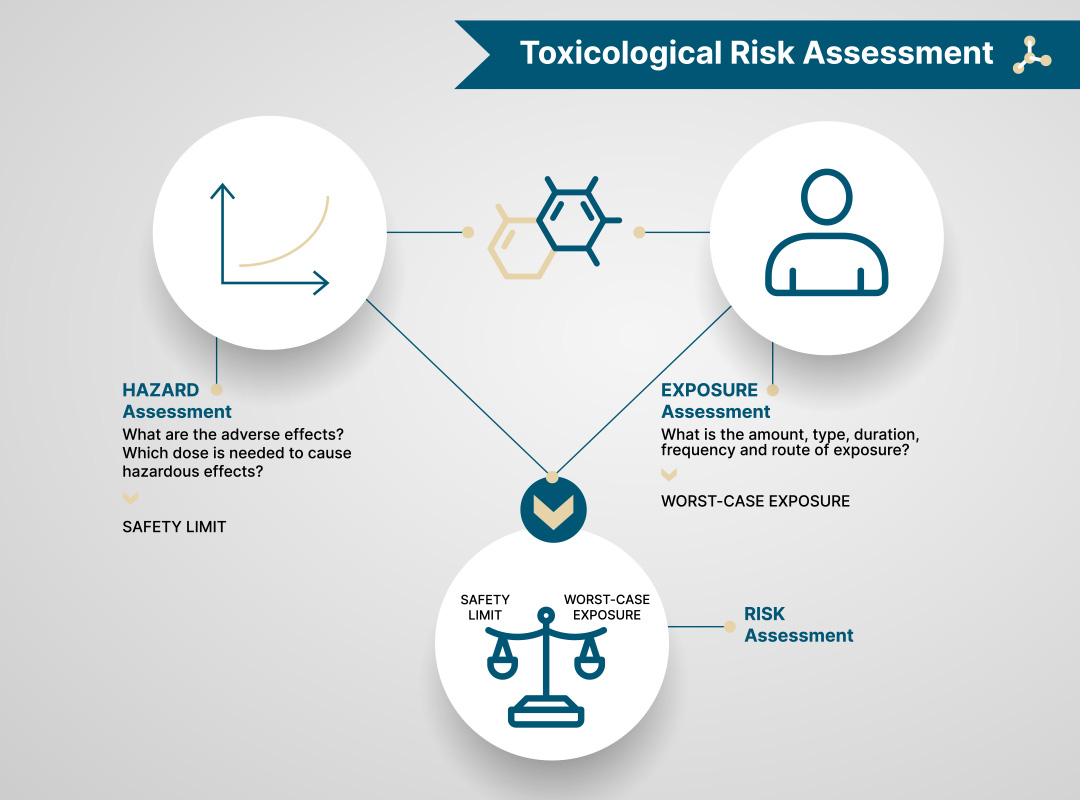
Assessments integrate hazard identification, hazard characterisation, exposure assessment, and risk characterisation to determine whether identified risks can be adequately characterised and controlled under the intended conditions of use.
Scientific conclusions are based on the totality of the available evidence. Depending on the available data and regulatory context, modern approaches, including read-across, (Q)SAR modelling, New Approach Methodologies (NAMs), and Integrated Approaches to Testing and Assessment (IATA), are incorporated where appropriate to address data gaps, strengthen weight-of-evidence evaluations, reduce uncertainty, and support scientifically sound decision-making.
The selected approach is driven by the available evidence, regulatory context, and the specific scientific questions that need to be addressed.
Regulatory submissions require more than scientific data alone. Toxicological information must be clearly interpreted, scientifically justified, and presented in a format that meets regulatory expectations.
Agirad supports organisations with the preparation and review of regulatory toxicology documentation for product development, regulatory submissions, lifecycle management, and interactions with regulatory authorities.
Support includes:
Documentation is tailored to the product category, regulatory pathway, available evidence, and specific scientific questions, ensuring clear and scientifically defensible communication with regulatory authorities.
Pharmaceutical development requires scientifically justified toxicological assessments to support product safety, regulatory submissions, and lifecycle management. Agirad supports evaluations related to active substances, impurities, excipients, manufacturing-related substances, and occupational exposure in accordance with applicable ICH, EMA, and VICH guidance.
Toxicological risk assessment expertise includes:
Regulatory submission support includes
Medical device safety evaluations require a scientifically justified assessment of chemical exposure, biological effects, and patient risk. Agirad supports manufacturers with toxicological risk assessments and biological safety evaluations in accordance with ISO 10993 requirements.
Toxicological risk assessment expertise includes:
Regulatory submission support includes:
Support integrates chemical characterisation, toxicological risk assessment, weight-of-evidence evaluation, and current regulatory expectations.
Chemical safety evaluations require robust human health risk assessments based on realistic exposure scenarios and current regulatory requirements. Agirad supports manufacturers and downstream users with human health risk assessments and regulatory toxicology evaluations for substances under REACH and other regulatory frameworks.
Toxicological risk assessment expertise includes:
Regulatory submission support includes:
Not every safety question fits within a predefined regulatory pathway. Complex toxicological challenges often require scientific judgement, integration of multiple evidence sources, and a clear regulatory strategy.
Agirad provides independent expertise for complex toxicological questions, including:
By combining regulatory experience with practical toxicology, Agirad helps organisations develop scientifically justified approaches for complex safety decisions and build internal capabilities to address evolving regulatory challenges.
Whether you require support with a toxicological risk assessment, regulatory submission, health-based exposure limits, or a complex safety question, Agirad provides independent scientific expertise to help define the appropriate regulatory strategy.
Contact Agirad to discuss your project requirements and identify the most appropriate scientific strategy for your product development and regulatory objectives.
A regulatory toxicologist evaluates scientific data to determine whether a substance or product can be used safely under defined exposure conditions and regulatory requirements. Regulatory toxicologists assess hazards, evaluate human exposure, establish health-based limits, prepare scientific documentation, and support regulatory decision-making throughout product development and approval processes.
An independent regulatory toxicologist provides objective scientific expertise to support safety evaluations, regulatory decisions, and risk management strategies. Independence allows toxicological data to be critically assessed without commercial interests influencing the scientific interpretation or outcome.
The role includes evaluating available evidence, identifying uncertainties, developing scientifically justified approaches, and supporting organisations with regulatory submissions, authority interactions, and complex safety questions. By combining regulatory knowledge with practical toxicology experience, an independent regulatory toxicologist helps organisations make transparent, evidence-based decisions throughout the product lifecycle.
Agirad provides independent regulatory toxicology and human health risk assessment services for pharmaceutical, veterinary pharmaceutical, medical device, chemical, food, feed, and cosmetics industries.
Toxicological assessments include:
Each assessment is tailored to the product type, intended use, exposure scenario, available scientific evidence, and applicable regulatory requirements.
A toxicological risk assessment (TRA) is a scientific process used to determine whether exposure to a chemical substance could pose a risk to human health under specific conditions of use. It combines information on the toxicological properties of a substance and the expected level of exposure to determine whether potential risks are acceptable.
The assessment is based on four core components:
The outcome of a TRA is a scientifically justified conclusion on whether the identified risk is acceptable under defined conditions of use. If uncertainties remain or risks are not adequately controlled, additional data generation, risk management measures, or use restrictions may be required to achieve regulatory acceptability.
A toxicological risk assessment is required whenever the safety of a chemical substance, material, or product must be demonstrated for human exposure.
TRAs are routinely prepared to support:
They are widely used across industries including:
A toxicological risk assessment may also be necessary when introducing a new substance, modifying a formulation, changing manufacturing processes, or when existing safety data are insufficient to demonstrate safe use.
A toxicological risk assessment is relevant for any organization that develops, manufactures, imports, or markets products that may result in human exposure to chemical substances.
Typical users include:
The scope of the assessment depends on several factors, including the substance involved, the intended use, expected exposure, target population, and applicable regulatory requirements.
A well-prepared toxicological risk assessment helps organizations demonstrate product safety, support regulatory submissions, and reduce compliance risks.
A toxicological risk assessment (TRA) relies on high-quality scientific data to evaluate whether human exposure to a substance is safe under its intended conditions of use. The amount and type of information required depend on the substance, exposure scenario, regulatory framework, and available evidence.
A comprehensive toxicological risk assessment typically includes:
The strength of a toxicological risk assessment depends on the quality, relevance, and completeness of the available evidence. When data are limited, scientifically accepted approaches such as read-across, weight-of-evidence evaluations, and computational toxicology can often be used to support a robust safety assessment.
Regulatory submissions require clear, scientifically justified toxicological information that meets the expectations of regulatory authorities. Agirad supports organisations by preparing, reviewing, and strengthening toxicology documentation throughout the regulatory process.
Support includes:
By combining regulatory toxicology expertise with an understanding of applicable guidelines and scientific principles, Agirad helps organisations communicate complex safety information clearly, address regulatory questions effectively, and support informed regulatory decision-making.
Read-across and (Q)SAR approaches are scientific methods used to support toxicological assessments when experimental data are limited or when additional evidence is needed to evaluate safety.
Read-across uses toxicological information from similar substances to predict potential effects of a target substance, based on similarities in chemical structure, properties, or biological activity.
(Q)SAR (Quantitative Structure–Activity Relationship) models use relationships between chemical structure and biological activity to predict specific toxicological properties.
These approaches can support:
When scientifically justified, read-across and (Q)SAR approaches provide valuable evidence for regulatory toxicology assessments. Their reliability depends on appropriate data selection, model applicability, and transparent evaluation of uncertainties.
A regulatory toxicology consultant should have a strong scientific background in toxicology, experience performing human health risk assessments, and knowledge of relevant regulatory frameworks.
Key qualifications include:
Professional recognition, such as Eurotox Registered Toxicologist (ERT) or Diplomate of the American Board of Toxicology (DABT), provides additional evidence of toxicology expertise and professional competence.
A qualified regulatory toxicologist combines scientific knowledge with regulatory experience to develop transparent, scientifically justified assessments that support product safety and regulatory decision-making.
Not all toxicological questions can be addressed through standard assessment pathways. Agirad provides independent scientific support for complex safety questions that require expert judgement, interpretation of available evidence, and development of scientifically justified regulatory strategies.
Support includes:
By integrating toxicological expertise, regulatory knowledge, and evidence-based approaches, Agirad helps organisations address challenging safety questions, reduce uncertainty, and develop clear, scientifically defensible conclusions.