
Endocrine disruptors under REACH and CLP in 2026
Questions?
Want to know more about our services? Call, mail, or send us a message.
Other news
Endocrine disruptors under REACH and CLP in 2026: What companies need to know about current requirements, OECD developments and the future of REACH
Summary
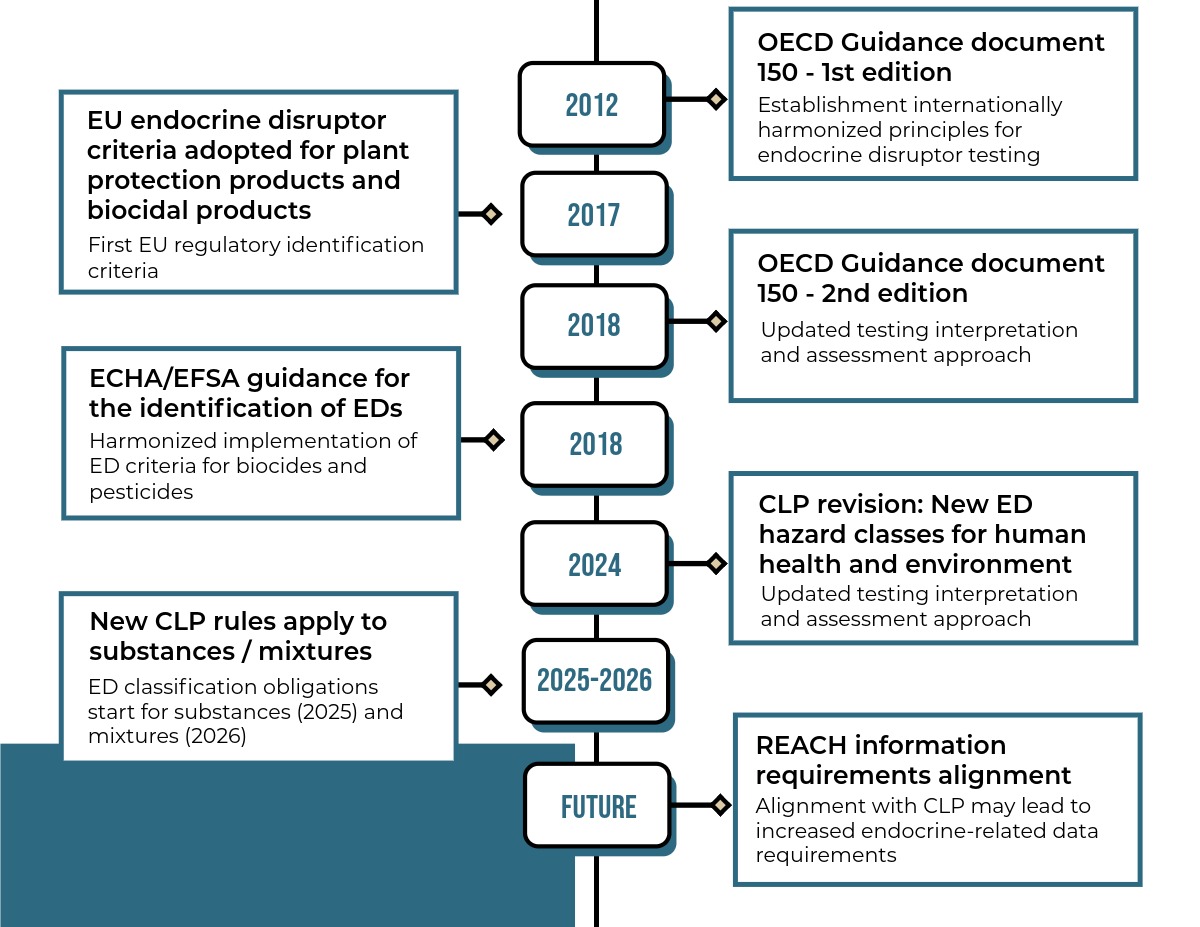
Endocrine disruptors under REACH and CLP have become one of the most important and rapidly evolving topics in European chemicals legislation. The regulatory landscape is changing through the introduction of new endocrine disruptor hazard classes under the EU Classification, Labelling and Packaging (CLP) Regulation, ongoing discussions on future REACH requirements, and continued scientific developments in endocrine disruptor assessment.
Although endocrine-disrupting properties were already considered under sector-specific legislation such as the Biocidal Products Regulation (BPR) and the Plant Protection Products Regulation (PPPR), the introduction of dedicated endocrine disruptor hazard classes under CLP represents a significant regulatory milestone. Companies must now consider endocrine-disrupting properties when classifying and labelling substances.
However, the REACH Regulation has not yet introduced dedicated endocrine disruptor information requirements in Annexes VII–X. As a result, a substance may require classification as an endocrine disruptor under CLP even though REACH does not prescribe a specific endocrine disruptor testing package. This regulatory gap can create uncertainty for registrants, who increasingly need to evaluate endocrine-related data and conduct weight-of-evidence assessments despite the absence of standard endocrine disruptor testing requirements.
In addition, the scientific framework for endocrine disruptor identification continues to evolve. The Organisation for Economic Co-operation and Development (OECD) is expanding testing methodologies, updating guidance, and supporting approaches such as New Approach Methodologies (NAMs), Integrated Approaches to Testing and Assessment (IATA), and Adverse Outcome Pathways (AOPs).
Understanding the relationship between REACH, CLP, OECD guidance, and endocrine disruptor assessment is therefore becoming increasingly important for regulatory affairs professionals, toxicologists, product stewards, and chemical manufacturers. This article explains the current regulatory framework in 2026, outlines key scientific and regulatory developments, and discusses what companies should expect as REACH and CLP continue to evolve.
Part 1 – The regulatory landscape for endocrine disruptors under REACH and CLP
1. What is an endocrine disruptor?
According to internationally accepted definitions developed by the World Health Organization (WHO) and the International Programme on Chemical Safety (IPCS), an endocrine disruptor is an exogenous substance or mixture that alters the function of the endocrine system and consequently causes adverse effects in an intact organism, its offspring or populations.
Importantly, regulatory identification of an endocrine disruptor requires more than demonstrating that a substance interacts with a hormone receptor or affects an endocrine pathway. A substance is generally identified as an endocrine disruptor only when three scientific elements are established:
- Endocrine activity: Evidence that the substance interacts with or alters endocrine pathways.
- Adverse effects: Evidence that the endocrine activity leads to harmful biological outcomes.
- Biologically plausible link: Evidence demonstrating a scientifically credible relationship between endocrine activity and the observed adverse effect.
Because all three elements must be considered together, endocrine disruptor identification is often more complex than traditional hazard assessment. Rather than relying on a single study or endpoint, regulatory authorities apply a weight-of-evidence approach, integrating information from multiple sources to determine whether the criteria are fulfilled.
2. Why have endocrine disruptors become a regulatory priority?
Over the last two decades, scientific evidence has increasingly linked endocrine disruption to:
- Reproductive disorders
- Developmental toxicity
- Thyroid dysfunction
- Metabolic disorders
- Neurodevelopmental effects
- Effects on wildlife populations and ecosystems
Historically, many of these effects were evaluated through existing reproductive and developmental toxicity endpoints. However, growing scientific understanding demonstrated that endocrine disruption represents a distinct mode of action that cannot always be adequately captured by traditional hazard assessments alone.
This recognition prompted regulators to develop dedicated scientific criteria and assessment frameworks for endocrine disruptors, ultimately leading to their formal inclusion as hazard classes under the CLP Regulation.
3. What changed for endocrine disruptors under the CLP regulation?
One of the most significant recent developments in EU chemicals legislation was the introduction of dedicated hazard classes for endocrine disruptors through Commission Delegated Regulation (EU) 2023/707, which amended the CLP Regulation. For the first time, endocrine disruption is recognised as a standalone hazard class alongside established health hazards such as carcinogenicity, mutagenicity and reproductive toxicity.
The revised CLP Regulation introduced dedicated hazard classes for endocrine disruptors affecting:
- Human Health (ED HH): Substances that meet the criteria for endocrine disruption in humans.
- The Environment (ED ENV): Substances that meet the criteria for endocrine disruption in non-target organisms and ecosystems.
Within each hazard class, substances can be classified into two categories:
- Category 1 – Assigned where the available scientific evidence demonstrates that a substance is an endocrine disruptor. Classification may be based on human data, animal studies, or other scientifically robust evidence.
- Category 2 – Assigned where the available evidence raises concern for endocrine disruption but is not sufficiently conclusive to support a Category 1 classification.
For many substances, regulatory discussions will focus on whether the available data provide sufficient certainty for Category 1 classification or whether remaining uncertainties justify Category 2. Understanding these distinctions is becoming increasingly important for dossier preparation, classification decisions and regulatory strategy.
As a result, companies placing substances on the European market must now consider endocrine-disrupting properties as part of their CLP classification and labelling obligations.
Read our article on “New CLP hazard classes“
4. Does REACH require endocrine disruptor testing?
Not yet.
As of 2026, the standard information requirements in REACH Annexes VII to X do not include a dedicated testing package specifically designed to identify endocrine-disrupting properties.
This does not mean that endocrine disruption is ignored under REACH. Existing toxicological studies may already provide relevant information, and endocrine-disrupting properties can be evaluated during dossier evaluation, substance evaluation or other regulatory processes carried out by ECHA and the Member State Competent Authorities.
In practice, endocrine disruptor assessments currently rely on a combination of:
- Existing toxicological studies
- Mechanistic evidence
- Scientific literature
- Read-across approaches
- Weight-of-evidence evaluations
- Additional information requests during dossier or substance evaluation
Consequently, companies may already need to evaluate endocrine-disrupting properties when preparing REACH registrations or responding to regulatory requests, even though REACH does not yet contain dedicated endocrine disruptor information requirements.
At the same time, the same substance may require classification as an endocrine disruptor under the CLP Regulation, creating new obligations for classification, labelling and safety data sheets.
For more information on deadlines, read our article on “New CLP hazard classes
5. Why are REACH and CLP not yet aligned?
One of the questions most frequently raised by regulatory professionals is why endocrine disruptor hazard classes have already been introduced under CLP while REACH has not yet incorporated corresponding information requirements.
However, the answer lies in the fundamentally different objectives of the two regulations.
The CLP Regulation focuses on hazard identification and communication. It establishes whether a substance should be classified and labelled based on its intrinsic hazardous properties.
The REACH Regulation, in contrast, focuses on information generation and risk management. It specifies which data registrants must generate to demonstrate the safe manufacture and use of substances placed on the European market.
Introducing endocrine disruptor hazard classes under CLP therefore required changes to the classification criteria. Introducing dedicated endocrine disruptor requirements under REACH would require amendments to Annexes VII–X. Such changes could affect testing strategies, registration dossiers and information requirements across multiple tonnage bands.
Part 2 – How endocrine disruptors are assessed today
6. How are endocrine disruptors assessed under EU chemicals legislation?
Unlike many traditional hazard endpoints, endocrine disruptor (ED) identification cannot be based on the outcome of a single study or test. Instead, regulators evaluate all available scientific information to determine whether a substance fulfils the criteria for endocrine disruption.
The weight of evidence approach
Across European chemicals legislation, endocrine disruptor assessment follows a weight-of-evidence approach, integrating information from multiple sources, including:
- Existing toxicological studies
- Mechanistic in vitro and in vivo data
- Scientific literature
- Human and epidemiological data, where available
- Computational methods, such as QSARs and read-across
- Expert scientific judgement
The objective is to determine whether three scientific elements are present:
- Evidence of endocrine activity;
- Evidence of an adverse effect; and
- A biologically plausible link between the endocrine activity and the adverse effect.
Rather than relying on a single “endocrine disruptor test”, regulatory authorities combine multiple lines of evidence to reach a scientifically robust conclusion. This integrated approach forms the basis of endocrine disruptor identification under European chemicals legislation and is reflected in OECD Guidance Document 150 and the joint ECHA/EFSA Guidance.
7. How does ECHA assess endocrine disruptors?
The European Chemicals Agency (ECHA) plays a central role in the implementation of endocrine disruptor assessments across several regulatory processes. REACH does not yet contain dedicated endocrine disruptor information requirements. Nevertheless, endocrine-disrupting properties are already considered when relevant scientific evidence is available.
Endocrine disruptor assessments may influence:
- REACH dossier evaluations and compliance checks;
- Substance evaluations performed by Member State Competent Authorities;
- Harmonised Classification and Labelling (CLH) proposals under CLP;
- Identification of Substances of Very High Concern (SVHCs);
- Authorisation decisions under REACH;
- Restriction proposals; and
- ECHA’s Assessment of Regulatory Needs (ARNs), which help identify substances requiring further regulatory action.
For registrants, this means that endocrine disruptor assessment is no longer a future consideration. It is already an important element of regulatory strategy and may influence data generation, classification decisions, and long-term substance management.
8. OECD Guidance Document 150 and the OECD conceptual framework
A major milestone in the scientific assessment of endocrine disruptors was the development of the OECD Conceptual Framework for the Testing and Assessment of Endocrine Disrupting Chemicals, supported by OECD Guidance Document 150.
Rather than prescribing a fixed testing strategy, the Conceptual Framework provides a structured approach for organising and interpreting scientific information according to five levels of biological complexity. It serves as a toolbox for selecting appropriate methods based on the regulatory question, existing information, and the overall weight of evidence.
The five levels are:
Level 1 - Existing information and non-test information
This level includes existing knowledge such as physicochemical properties, available toxicological studies, exposure information, structure–activity relationships (QSARs), read-across, and other non-test information that may provide indications of endocrine activity.
Level 2 - In vitro mechanistic
Level 2 focuses on mechanistic assays that investigate interactions with endocrine pathways, including estrogen, androgen, thyroid and steroidogenesis (EATS) modalities. These assays provide information on endocrine activity but do not demonstrate adverse effects.
Level 3 - In vivo mechanistic
At this level, mechanistic responses are evaluated in intact organisms. These studies investigate whether endocrine activity observed in vitro results in measurable biological responses within a whole organism.
Level 4 - In vivo studies addressing adverse effects
Level 4 includes studies designed to detect adverse effects that may result from endocrine disruption, such as reproductive, developmental or endocrine-related toxicity.
Level 5 - In vivo studies covering more comphrenseive life-cycle effects
The highest level includes studies assessing adverse effects across sensitive life stages or, where relevant, population-level impacts. These studies provide the most comprehensive evidence for evaluating endocrine-disrupting properties.
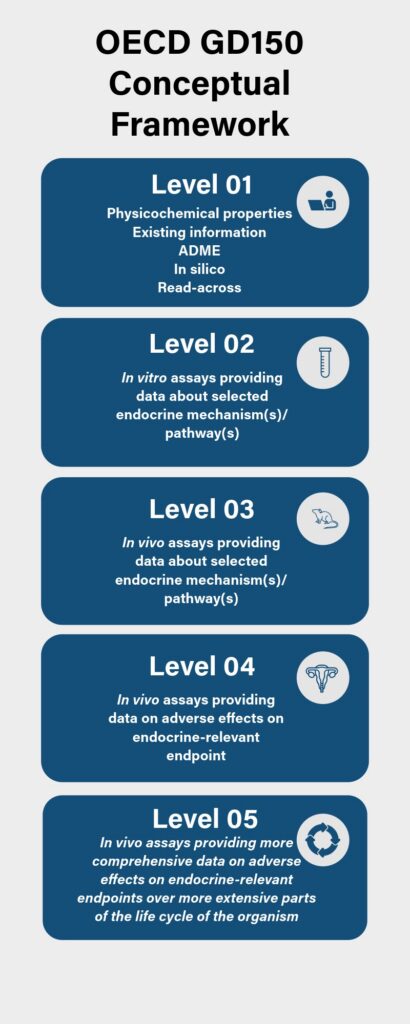
Importantly, the five levels do not represent a mandatory stepwise testing sequence. Instead, they support the integration of multiple evidence streams within a scientifically justified weight-of-evidence assessment.
9. OECD test guidelines supporting endocrine disruptor assessment
Furthermore, the OECD conceptual framework is supported by a series of OECD test guidelines covering different levels of biological evidence. These methods address key endocrine pathways, including estrogen, androgen, thyroid, and steroidogenesis (EATS) modalities.
Relevant OECD Test Guidelines include, among others:
- In vitro mechanistic assays (Level 2), such as receptor binding and activation assays, which investigate whether a substance can interact with endocrine pathways (e.g. the Estrogen Receptor Transactivation Assay (OECD TG 455), the Androgen Receptor Transactivation Assay (OECD TG 458), and the H295R Steroidogenesis Assay (OECD TG 456)).
- In vivo mechanistic studies (Level 3), which provide information on endocrine-related responses in an intact organism (e.g. Uterotrophic Bioassay (OECD TG 440) and the Hershberger Bioassay (OECD TG 441)).
- In vivo studies assessing adverse effects (Levels 4 and 5), including repeated dose toxicity, reproductive and developmental toxicity studies that can identify consequences associated with endocrine disruption.
Recent revisions of several OECD Test Guidelines have expanded the evaluation of endocrine-relevant endpoints, including hormone measurements, anogenital distance, nipple retention, estrous cyclicity, thyroid parameters and endocrine organ histopathology. These additions reflect the continuous evolution of endocrine disruptor science and improve the ability to identify endocrine-mediated effects.
10. ECHA/EFSA guidance: The foundation of EU endocrine disruptor identification
An important milestone in European endocrine disruptor regulation was the publication of the joint ECHA/EFSA Guidance for the identification of endocrine disruptors.
Originally developed to support implementation of the endocrine disruptor criteria under the Biocidal Products Regulation (BPR) and the Plant Protection Products Regulation (PPPR), the guidance has become the scientific reference for endocrine disruptor identification within the European Union.
Importantly, the guidance emphasises that endocrine disruptor identification should be based on a transparent weight-of-evidence assessment integrating all relevant scientific information. Particular attention is given to three key elements:
- Evidence of endocrine activity;
- Evidence of adverse effects; and
- A biologically plausible link between the endocrine activity and the adverse effect.
Rather than relying on individual studies in isolation, the guidance promotes a comprehensive evaluation of mechanistic data, in vitro assays, in vivo studies, published scientific literature and expert judgement.
The principles described in the ECHA/EFSA Guidance are closely aligned with OECD Guidance Document 150 and continue to underpin endocrine disruptor assessments across European chemicals legislation, including the implementation of the new CLP hazard classes.
11. Beyond EATS: expanding the scope of endocrine disruptor assessments
Most current regulatory assessment methods focus on four major endocrine pathways collectively referred to as the EATS modalities:
- Estrogen;
- Androgen;
- Thyroid; and
- Steroidogenesis.
These pathways form the scientific foundation of most existing OECD test methods and regulatory assessment strategies.
However, endocrine biology extends far beyond the EATS pathways. Recent scientific developments have increased attention on additional endocrine mechanisms, including:
- Insulin signalling and metabolic regulation;
- Glucocorticoid signalling;
- Retinoid pathways;
- Peroxisome proliferator-activated receptor (PPAR) pathways; and
- Other non-EATS endocrine mechanisms.
The OECD’s State of the Science of Endocrine Disrupting Chemicals highlights these non-EATS mechanisms as an important area for future research and method development. While current regulatory frameworks remain primarily centred on EATS modalities, future assessment strategies are expected to broaden as scientific understanding and validated test methods continue to evolve.
12. NAMs, IATA and AOPs are reshaping endocrine disruptor assessment
Regulatory toxicology is increasingly moving towards more mechanistic, animal-sparing approaches for hazard assessment.
New Approach Methodologies (NAMs) include advanced in vitro models, computational toxicology, in silico modelling, transcriptomics, omics technologies and high-throughput screening methods.
These methods are increasingly combined within Integrated Approaches to Testing and Assessment (IATA), which use multiple evidence streams to answer regulatory questions while reducing unnecessary testing.
An important component of this evolution is the development of Adverse Outcome Pathways (AOPs). AOPs describe the sequence of key biological events linking a molecular initiating event to adverse outcomes observed in organisms or populations. They provide a mechanistic framework that supports interpretation of experimental data and strengthens weight-of-evidence assessments.
Together, NAMs, IATA and AOPs are expected to play an increasingly important role in endocrine disruptor assessment and in the future evolution of European chemicals legislation.
13. What can we expect from future REACH requirements for endocrine disruptors?
Although REACH Annexes VII–X do not yet contain dedicated endocrine disruptor information requirements, the regulatory direction is clear. The European Commission has indicated its intention to improve the coherence between REACH and CLP as part of the broader revision of EU chemicals legislation.
Possible future regulatory developments
For example, future developments may include:
- Better alignment between REACH information requirements and the CLP endocrine disruptor hazard classes;
- Increased use of mechanistic evidence and weight-of-evidence assessments;
- Greater acceptance of New Approach Methodologies (NAMs);
- Further integration of Integrated Approaches to Testing and Assessment (IATA) and Adverse Outcome Pathways (AOPs);
- Continued development of validated OECD test methods; and
- Improved consistency across European chemicals legislation.
While the exact legislative proposals and implementation timelines remain under development, companies should already consider endocrine disruptor assessment as an integral part of their regulatory strategy. Preparing for these future changes today will help ensure compliance with tomorrow’s regulatory requirements.
Part 3 – What this means for industry
14. What do endocrine disruptors under REACH and CLP mean for registrants?
Although REACH does not yet contain dedicated information requirements for endocrine disruptor assessment, endocrine-disrupting properties are already influencing regulatory decision-making. Consequently, companies should not view endocrine disruptor assessment as a future compliance issue but as an increasingly important element of their current regulatory strategy.
Depending on the available scientific evidence and the regulatory context, endocrine-disrupting properties may affect several regulatory processes.
REACH dossier evaluation
During dossier evaluation, ECHA may examine whether the available information adequately addresses concerns relating to endocrine-disrupting properties. Where justified, registrants may be requested to clarify existing data or generate additional information.
Substance evaluation
Member State Competent Authorities may identify endocrine disruption as a concern during substance evaluation. This can lead to requests for additional information to clarify the hazard profile of a substance.
Harmonised classification and labelling (CLH)
The introduction of endocrine disruptor hazard classes under the CLP Regulation means that substances may become subject to harmonised classification proposals for endocrine disruption. Such classifications can have important downstream consequences for labelling, Safety Data Sheets (SDS), supply chain communication and risk management.
Identification as a Substance of Very High Concern (SVHC)
Under REACH Article 57(f), substances with endocrine-disrupting properties may be identified as Substances of Very High Concern (SVHCs) where they are considered to present an equivalent level of concern to carcinogenic, mutagenic or reproductive toxicants. SVHC identification can ultimately lead to inclusion on the Candidate List and, potentially, the Authorisation List.
Future REACH information requirements
Although no dedicated endocrine disruptor information requirements have yet been adopted for REACH Annexes VII–X, future revisions of the Regulation may introduce more explicit requirements for generating and assessing endocrine-related information. Companies that already understand the endocrine disruptor profile of their substances will be better positioned to respond to future regulatory developments.
Ultimately, the key message is clear: endocrine disruptor assessment is no longer solely a scientific exercise. It is increasingly becoming a strategic component of regulatory compliance, product stewardship and long-term portfolio management.
15. How can companies prepare today?
The regulatory framework for endocrine disruptors continues to evolve. Rather than waiting for future legislative changes, companies can already take practical steps to strengthen their regulatory preparedness.
Review existing data
Start by reviewing available toxicological studies to identify information relevant to endocrine disruption. In many cases, valuable evidence already exists within REACH registration dossiers but has not been assessed specifically from an endocrine disruptor perspective.
Evaluate endocrine-relevant endpoints
Consider whether existing studies include endocrine-sensitive endpoints such as hormone measurements, reproductive and developmental parameters, thyroid effects, anogenital distance, nipple retention or histopathological findings in endocrine organs.
Assess mechanistic evidence
Mechanistic data, including information from in vitro assays, published literature and computational approaches, can provide valuable evidence of endocrine activity. Such information should be evaluated alongside traditional toxicity studies within a structured weight-of-evidence assessment.
Consider implications for CLP classification
Companies should assess whether the available evidence may support classification under the endocrine disruptor hazard classes introduced by the revised CLP Regulation. Early evaluation allows sufficient time to prepare for classification, labelling and Safety Data Sheet updates.
Apply a structured weight-of-evidence approach
Endocrine disruptor assessment requires the integration of multiple evidence streams rather than reliance on individual studies. A transparent and scientifically justified weight-of-evidence assessment is therefore essential for robust regulatory decision-making.
Monitor regulatory and scientific developments
The scientific and regulatory landscape continues to evolve rapidly. Companies should follow updates from the OECD, ECHA, EFSA and the European Commission, particularly regarding new OECD Test Guidelines, revisions to guidance documents and future changes to REACH information requirements.
Explore New Approach Methodologies (NAMs)
Advances in New Approach Methodologies (NAMs), Integrated Approaches to Testing and Assessment (IATA) and Adverse Outcome Pathways (AOPs) are expected to play an increasingly important role in endocrine disruptor assessment. Understanding how these approaches can complement existing datasets will help companies prepare for the next generation of regulatory toxicology.
Build a proactive regulatory strategy
Perhaps the most important step is to adopt a proactive rather than reactive approach. Companies that understand the endocrine disruptor profile of their substances today will be better prepared for future regulatory scrutiny, evolving CLP obligations and potential revisions of REACH.
In practice, one of the greatest challenges is often not the absence of data, but the systematic interpretation of existing information using the scientific principles established in OECD Guidance Document 150 and the ECHA/EFSA Guidance. Organisations that invest in this expertise now are likely to be better positioned as endocrine disruptor assessment continues to evolve across European chemicals legislation.
Key takeaways for endocrine disruptors under REACH and CLP
The key takeaways regarding endocrine disruptors under REACH and CLP are:
- Endocrine disruptors are now a formal hazard class under the CLP Regulation. Companies must consider endocrine-disrupting properties when classifying and labelling substances and mixtures.
- REACH and CLP are currently not fully aligned. While CLP introduces dedicated hazard classes for endocrine disruptors, REACH Annexes VII–X do not yet include specific information requirements for endocrine disruptor assessment.
- Endocrine disruptor identification is based on a weight-of-evidence approach. Regulators assess endocrine activity, adverse effects and a biologically plausible link by integrating multiple lines of scientific evidence rather than relying on a single test.
- OECD Guidance Document 150 and the OECD Conceptual Framework provide the scientific foundation for endocrine disruptor assessment, supported by an expanding suite of OECD Test Guidelines.
- The ECHA/EFSA Guidance remains the cornerstone of endocrine disruptor identification in Europe, providing a transparent framework for evaluating endocrine-disrupting properties across regulatory processes.
- Scientific assessment continues to evolve. New Approach Methodologies (NAMs), Integrated Approaches to Testing and Assessment (IATA), Adverse Outcome Pathways (AOPs) and research into non-EATS mechanisms are shaping the future of endocrine disruptor assessment.
- Accordingly, companies should not wait for future REACH revisions. Reviewing existing datasets, evaluating endocrine-relevant information and preparing robust weight-of-evidence assessments today will strengthen regulatory readiness for tomorrow.
How Agirad can support endocrine disruptor assessments
Understanding endocrine disruptors under REACH and CLP requires more than checking whether studies are available. It requires interpreting diverse sources of information within a scientifically robust and regulatory accepted framework.
Whether you are preparing a REACH registration, evaluating CLP classification, responding to an ECHA information request or assessing the regulatory impact of endocrine-disrupting properties, a structured strategy can help avoid unnecessary delays and strengthen the scientific basis of your dossier.
Our regulatory toxicology experts support companies with:
- Endocrine disruptor weight-of-evidence assessments
- REACH registration and dossier updates
- CLP classification for endocrine disruptor hazard classes
- Literature reviews and data gap analyses
- Regulatory strategy and scientific justification
- OECD and ECHA guidance interpretation
If you would like to discuss how endocrine disruptor assessment may affect your substances or products, feel free to contact our regulatory experts.
Frequently
Asked Questions
Endocrine disruption overview
An endocrine disruptor is an exogenous substance or mixture that alters the function of the endocrine system and consequently causes adverse effects in an intact organism, its offspring or (sub)populations. Regulatory identification requires evidence of endocrine activity, an adverse effect and a biologically plausible link between the two.
Endocrine disruptors have been associated with effects on reproduction, development, thyroid function, metabolism, and wildlife populations. Their complex modes of action have led regulators to develop dedicated assessment frameworks.
EATS stands for Estrogen, Androgen, Thyroid and Steroidogenesis. These four endocrine pathways form the basis of most current OECD test methods and regulatory assessments for endocrine disruption.
Regulatory framework: REACH and CLP
Commission Delegated Regulation (EU) 2023/707 introduced new hazard classes for endocrine disruptors affecting human health (ED HH) and the environment (ED ENV). Companies must now evaluate whether substances or mixtures meet the criteria for classification under these hazard classes.
No. As of 2026, the standard information requirements in REACH Annexes VII–X do not include a dedicated endocrine disruptor testing package. However, endocrine-disrupting properties may still be evaluated during regulatory processes using existing data, mechanistic evidence and weight-of-evidence assessments.
The European Commission has indicated its intention to improve the coherence between REACH and CLP as part of the ongoing revision of EU chemicals legislation. Although no final legislative proposal has yet introduced dedicated endocrine disruptor information requirements into REACH Annexes VII–X, future revisions are expected to further strengthen the assessment of endocrine-disrupting properties.
Yes. Under Article 57(f) of REACH, substances with endocrine-disrupting properties may be identified as Substances of Very High Concern (SVHCs) when they are considered to present an equivalent level of concern to carcinogenic, mutagenic or reproductive toxicants.
Scientific assessment of endocrine disruptors
Endocrine disruptors are assessed using a weight-of-evidence approach that integrates multiple sources of information, including toxicological studies, mechanistic data, scientific literature, human data where available, computational methods, and expert judgement.
Regulatory identification requires three elements: evidence of endocrine activity, evidence of an adverse effect, and a biologically plausible link between the two.
OECD Guidance Document 150 supports the assessment of endocrine-disrupting properties by providing a structured framework for interpreting scientific evidence. Together with the OECD Conceptual Framework, it organises available information into five levels of biological complexity and promotes a weight-of-evidence approach.
The ECHA/EFSA Guidance provides a scientific framework for identifying endocrine disruptors under European regulations. It supports a transparent weight-of-evidence assessment by integrating mechanistic information, in vitro and in vivo studies, toxicological data, and other relevant evidence.
The guidance focuses on establishing:
- endocrine activity,
- adverse effects,
- and a biologically plausible relationship between endocrine activity and the observed effects.
It is an important reference for endocrine disruptor assessments under EU chemicals legislation, including the implementation of endocrine disruptor hazard classes under CLP.
Industry implications
Companies should proactively review existing toxicological data, evaluate endocrine-relevant endpoints, assess potential implications for CLP classification, develop transparent weight-of-evidence assessments and monitor updates from the OECD, ECHA and the European Commission. Early preparation will help organisations respond efficiently as endocrine disruptor regulation continues to evolve.
Agirad supports companies with endocrine disruptor assessments, including weight-of-evidence evaluations, REACH and CLP regulatory strategy, literature reviews, data gap assessments, and scientific justification.